

Where it begins
Most projects begin with a landowner.
Since 1991, many of our projects have started the same way: a landowner invites us onto their property, and together we figure out what the stream needs. Projects on private land are always voluntary, and riparian projects come at no cost to the landowner.
Some landowners reach out about a creek that floods or erodes on their property. Others hope to see salmon return to their stream. Both are great reasons to get in touch!

The life of a project
From first visit to returning salmon.
- Finding the siteA landowner tells us about a stream on their property, or we identify a site where a fish passage barrier or a bare, eroding bank is holding salmon back.
- Site assessmentOur project managers walk the site, usually with the landowner, to see what the stream needs: shade along the banks, an open channel, spawning gravel, or all of the above.
- Design and permittingInstream projects are engineered and permitted before any work begins. Riparian projects get a planting plan matched to the site and the season.
- ConstructionOur professional crew handles the heavy work: fixing broken culverts or replacing them with bridges, installing large woody debris (LWD, whole trees and root wads that create the rearing and spawning habitat salmon need), and adding spawning gravel.
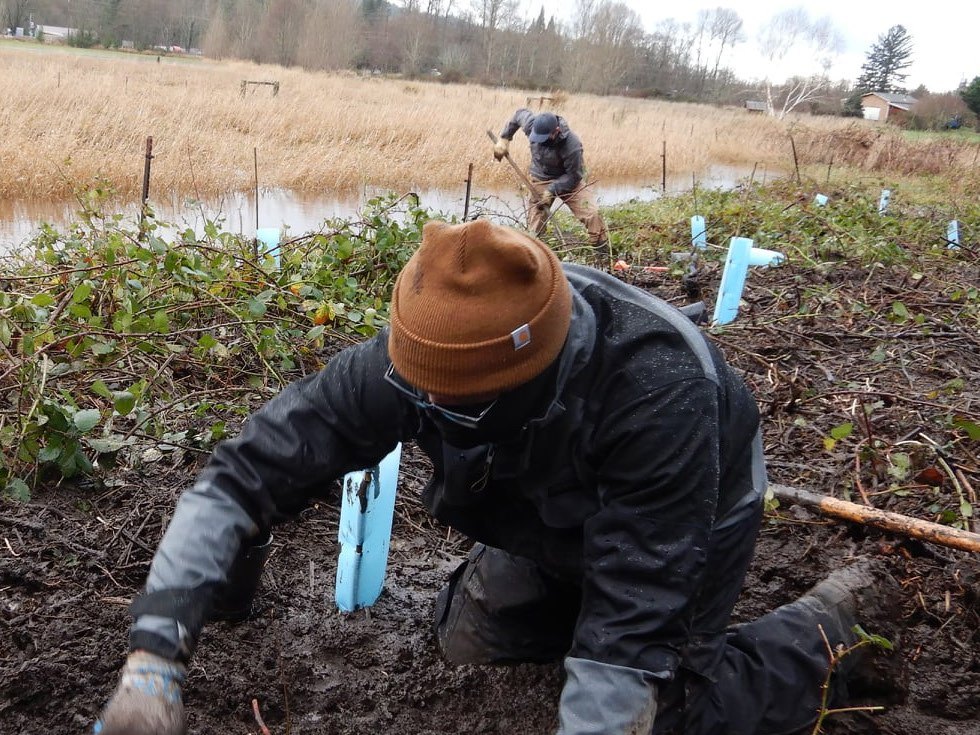
- PlantingVolunteers plant native trees and shrubs at Saturday work parties, restoring the shaded banks that keep the water clean, cold, and clear. Students plant too, through our Students for Salmon program.
- Monitoring and maintenanceWe return for years afterward to weed, replant, and watch for salmon using the site. We care for and monitor riparian projects across Whatcom County for years after the planting is done.
Who does what
Restoration takes the whole community.
Landowners
Landowners invite us onto their property and host the work. Many keep an eye on their site for years afterward.
Our crew
The professional field crew does the construction: heavy equipment, culvert replacement, and large woody debris installation. James van der Voort leads riparian projects and Eli DeWitt leads instream projects.
Volunteers
Community volunteers plant and maintain sites at work parties, Saturday mornings 9 to noon in spring and fall. We provide the tools, gloves, and training.
Students
Fourth graders in our Students for Salmon program cap their year with a student-led restoration project, planting native trees and shrubs at a local stream.
Why every site matters
Small streams count too.
Even small sections of improved streams, amid otherwise degraded habitat, can immediately provide an island of habitat for salmon. That is why we take on projects of every size, from a backyard creek to large-scale, multi-partner efforts that restore a long stretch of stream at once.
Those projects add up. Since 1991, NSEA has opened 147.8 miles of upstream habitat for migrating salmon, and there is still much work to be done. You can explore them all on our project map.

Start the conversation
Do you have a stream in need?
Tell us about it! Our For Landowners page walks through what a project can look like on your land, and it has the interest forms to get started.
Questions first? Email info@n-sea.org or call 360-715-0283.
Out in the field
See the work for yourself.
Explore where NSEA crews, volunteers, and students have been working since 1991, or come join a Saturday work party and see a project up close!